
Antti Louhivaara shares his story
My Journey as a
Loudspeaker Designer
My first contact with hi-fi happened when I was a pre-teen boy when our family bought a Salora Orthoperspecta Hi-Fi-system. It was a strange and unique sound system, developed by Tapio M. Köykkä, where the center speaker played summed mono information (L + R) in full range and the two side speakers played a difference signal (L – R and R – L), which mainly contained spatial information. The system was almost night and day different from standard stereos and because of this uniqueness alone, it aroused in the teenage boy an abiding and deep enthusiasm for sound.

Later in the early 80s, I began to study acoustics and loudspeaker technology in more detail. I was inspired by the Hifi magazine's construction kits at the time, and especially the special structure of the Gradient 1.0 loudspeaker. I wanted to understand how the above-mentioned loudspeakers work and which factors affect sound formation and thus sound quality. At that time, I started loudspeaker design as a hobby by modifying these existing Hifi magazine construction kit loudspeakers.
During the great depression in the early 90s in Finland, I really started studying loudspeaker technology and at the same time decided to start professional loudspeaker design. My first commercial loudspeaker model was the ASL H12nd, which also participated in the Tekniikan Maailma loudspeaker comparison (5/95). The result was a comparison win and thus the first test win in a long series of test wins for the loudspeakers I designed.
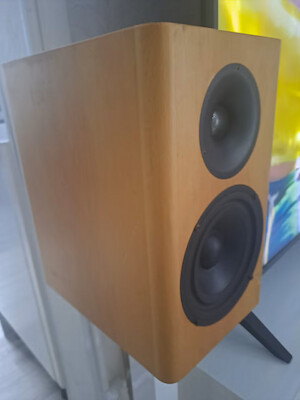
The turning point was getting to listen to a hi-fi enthusiast's door-sized Yankee panel speakers and at the same time comparing them to my own H12nd speakers. The experience was mind-blowing, mind-bending and ear-cleansing. It completely changed my perception of what a two-way system's spatial effect could be at its best. I realized at that moment that this was what I had to strive for in the future. Of course, I didn't know at the time how I would implement this. But this could be the beginning of my learning journey.
After this mind-blowing experience, I decided to deepen my studies in acoustics by reading the technical acoustics study materials from the Espoo University of Applied Sciences. I focused purely on studying the theory of acoustics and at the same time had discussions with people who had an impact in the field (including Juha Backman, Jorma Salmi, Pekka Tuomela, Anders Weckström). Based on these, I began to understand in which direction acoustic design should be developed further.
At this point, I began to understand the importance of both total radiation and, in particular, the importance of the dimensions of the radiator systems in relation to the length of the sound waves produced. This led to the so-called Wave-Length Reasoning (WLR) which would serve as a guiding principle in all my future designs. The core of the idea is that the radiators formed by the speaker elements should be in proportion to the wavelengths they produce. In this case, the radiation is as efficient as possible, so that the power required for the achievable sound pressure remains as low as possible (the resistive component of the radiation impedance is as high as possible). At the same time, the best possible integration between the element systems and uniform total radiation in different directions is achieved. Thus, the energy response is uniform and the directivity is controlled. The design principle is characterized by the use of large, flat waveguides in connection with the tweeter element. The first speaker model based on WLR technology was the ASL H7, which was introduced in 1995.

Amphion
In 1998, Amphion Loudspeakers Ltd was founded. Amphion’s first loudspeaker models were based on ASL loudspeaker prototypes. The original Amphion Argon is actually a further developed ASL H9. The first prototype of the Argon was made in an ASL H9 cabinet by replacing the original woofer with an aluminum cone woofer. The ASL H7 model’s waveguide was used as is in the Amphion Krypton and Amphion Neon/Neon+ models. The ASL H9 model’s waveguide shape was also inherited as is in the Helium/Helium+/Helium2/Creon/Athene/Ion models, only with a slightly smaller waveguide diameter. There’s no need to reinvent the wheel if it’s already worked flawlessly! In any case, the Argon won the very first speaker comparison test it entered and immediately became extremely popular in Finland. In addition to the Argon, the Neon+, Helium+, Helium2, Argon2, Creon2, and Impact500 (subwoofer) also won the comparison tests they participated in Finland.


Another speaker model released in 1998, the year Amphion was founded, was the Krypton, which featured a more advanced acoustic structure than previous models. The Krypton had 8” midrange drivers above and below a large waveguide (D’Appolito) in a rear-damped dipole structure. The bass was handled by a 10-inch driver mounted in a sealed enclosure. A year later, a revised version of the Krypton was introduced, with the midrange drivers mounted in so-called resistance enclosures.

In 2000, I designed the Amphion Xenon model, which introduced the so-called hypercardioid enclosure for the first time – the midrange element was adjusted to have the same directivity pattern as the waveguide-equipped tweeter element. The Argon2 model was also introduced around the same time as the Xenon. Both of these also introduced a completely new waveguide shape.

The Xenon and Argon2 garnered a lot of international attention and both models were praised to the skies by the international press. The Argon2 received the “Product of the Year” award from SoundStage! in 2002. The Helium2 also received a lot of praise from hi-fi journalists, including the “Runner Up 2005 Budget Product of the Year” award from Stereophile magazine.


Aurelia
However, it was time to move on. I founded a new company whose Aurelia speakers were first introduced at the 2007 Helsinki Hifi Fair. The premiere was the Aurelia Magenta, where I introduced the technology that had been further developed since the Amphion.
Aurelia Magenta became a huge success and was sold by the thousands both in Finland and abroad. Magenta, for example, was chosen as the best speaker of the year in France (“Best of 2012”, Hifi Video Home Cinema).
At the same time as Magenta, its big sister Aurelia Ambera was also introduced. Ambera was a floorstanding version of Magenta with two woofers. Ambera also became extremely popular and wiped the floor with the competition, winning all the comparison tests it participated in.
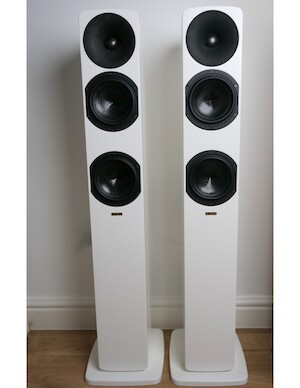
However, I wanted to develop existing acoustic methods further because I was not satisfied with the performance of the Krypton acoustic system. Although the Krypton sounded airy and ethereal due to its flat power response and strong directivity, there was a certain instability in the speaker and it was difficult to get it into good, stable balance. This is because the waveguide itself forms an omnipolar, spherical directional pattern that decays 6 dB with doubling the distance, while the midrange in the D’Appolito arrangement produces a cylindrical wave around the crossover frequency and this decays 3 dB with doubling the distance. In a design system like this, there is an obvious point of discontinuity here. Furthermore, the combination of a cylindrical wave and a spherical wave increases the instability.
The issue began to bother me over the years and I began to think about the best way to resolve this discontinuity in a way that would be both elegant and mathematically beautiful. I had to find a way to produce a coherent cylindrical wave over a sufficiently wide range of sound, starting from the upper bass range and continuing all the way to the top tweeter.

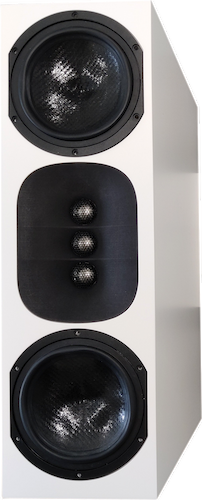
I developed a tweeter system in which three tweeter elements were placed vertically in a carefully shaped waveguide, the dimensions and steepness of which would produce a directivity pattern that would integrate perfectly with the midrange elements that were placed in line and produced the cylindrical wave.
The result was the Aurelia Graphica, introduced in 2008.
In the Graphica, the six-woofer acoustic line in the D’Appolito arrangement, together with the triple tweeter waveguide, forms a horizontal acoustic fan (Horizontal Fan-shaped Dispersion – HFD) that delivers significantly more direct, pure sound to the listening position than traditional acoustic systems. The end result is a three-dimensional, holographic soundscape.
The very first comparisons between the original Graphica prototype and the Amphion Krypton showed in lightning speed that the Graphica acoustic system nails it all in one go. Since then, I haven’t had to look back.”
In 2009, the Aurelia Cerica was introduced, a scaled-down stand version of the Graphica. The Cerica received extensive praise from the international press around the world and was awarded the “Recommended Reference Component” award by the international SoundStage! Hifi-net publication in 2013.

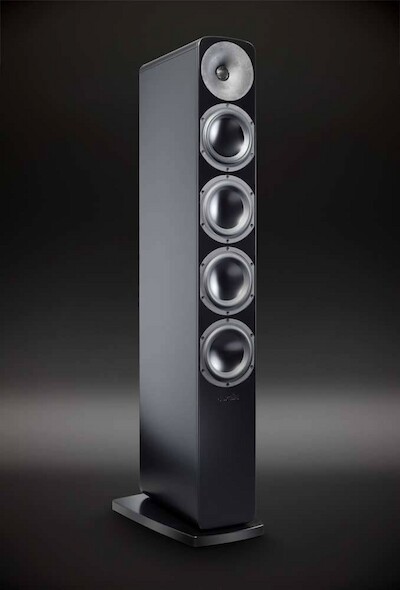
In 2010, the Aurelia Saphira was introduced. I designed the speaker from the beginning with home theater use in mind, and thanks to its four in-line bass elements, the Saphira had much more dynamics and punch than one might have expected from its slim appearance.
In 2012, the small Aurelia Aniara, injection-molded from natural fiber composite, was launched, which eventually became the most popular Aurelia model of all time.

Everyone loved Aniara, both at home and abroad. Aniara’s sound was balanced, lively, dynamic and easy to listen to. Considering its size, Aniara offered an exceptionally clean sound. In 2014, an active Aniara DSP model was also released, whose technology was based on modern digital signal processing.

As new products for 2016, I introduced larger versions of Cerica and Graphica, Cerica XL and Graphica XL.
The original 5.25” woofers in the speakers had been replaced with completely redesigned 6½” woofers with robust voice coils, which took the dynamics and bass extension of the new models to a whole new level.
Both models represented Aurelia’s most advanced level of sound quality, and in 2021 the Cerica XL received the highly regarded “Product of the Year 2021” recognition award for its innovative design from the international SoundStage!Hifi online publication:

However, it was time to move on again. I founded the ALD design office, which began designing new speaker models in 2021. The first speaker model designed by ALD was the AALTO 1, which was a further developed version of the Aurelia Aniara. An active model of the speaker, the AALTO 1pro, was also released:


I also developed the HFD technology further and introduced a second generation version of the triple tweeter:


In 2024, at the Warsaw AV Fair, I introduced the first fruit of this development, the Audio Anatomy AA5 speaker model, which was immediately praised. The novelty was considered “insanely” good and was chosen as the “Overall Bargain of The Show” product of the fair.”
ALD Speakers
The second fruit of the renewed HFD technology, the ALD A7, was introduced at the Helsinki Hifi Fair 2025. The A7 is a further developed version of the Aurelia Cerica XL model.
The new product for 2026 is the ALD A10, which goes even further acoustically than before. In this acoustic solution, I have adjusted the directional pattern both to the side and rear of the speaker to match the directional pattern of the triple tweeter. For this reason, the four midrange elements placed in the A10 line are placed in resistance boxes whose directional pattern has been adjusted to supercardioid. The speaker is thus almost constant directional and produces a coherent cylindrical wave up to 150 Hz. The lower limit frequency of the speaker is 60 Hz, which acts as a crossover frequency with the subwoofers used in connection with the speaker. The intention is to use a separate, high-quality subwoofer with each speaker.
So the speaker is a constant directional supercardioid radiator with a horizontal fan-shaped dispersion pattern. That’s the marketing name!
The ALD A10 sums up all the knowledge I have accumulated over the past 30 years and combines all the design techniques I have used during this time:
- Wave-Length Reasoning (WLR)
- Horizontal Fan-shaped Dispersion (HFD)
- Constant Directional Supercardioid Radiator

| Business ID: FI3122763-8