
Design Philosophy
The starting point of Antti Louhivaara's speaker design has never been to settle for mediocre solutions in any way. The goal from the beginning has been to create speaker models that differ from conventional implementations in terms of sound quality.
The basis of the design is an understanding of the typical conditions in which speakers are most often listened to. This is the basis for determining the key principles on which acoustic design is built. One of the most important starting points is the suitability of the speaker for the most common listening space: the living room.
Antti Louhivaara applies the knowledge he has developed over decades in his latest ALD speaker collection.
Listening Environment and Design Solutions
Design solutions must be clearly justifiable in all situations. The basic principles should be kept as clear and simple as possible, but not at any cost. Although simple is often beautiful, not everything beautiful is necessarily simple. The whole remains best under control when the design is based on the immutable laws of physics. Mere imagination or mysticism will not achieve a lasting result.
A living room places several restrictions on sound reproduction that can significantly impair listening enjoyment. The reverberation time is often quite long due to hard wall and floor materials. In addition, the standing waves and vibration echoes generated in the listening room significantly affect the sound quality. In order for a speaker to function as well as possible in such conditions, the basic elements of the design must be a flat energy response and correctly dimensioned directivity. When a speaker is able to create a balanced sound field and direct it in a controlled manner towards the listener, the effect that impairs the sound quality of the room is significantly reduced.
Thorough acoustic design forms the majority of the successful end result. When the acoustic foundation has been carefully made, the rest of the electrical design becomes significantly more straightforward. Naturally, the speakers also need to be measured, but even flawless measurement results do not necessarily guarantee a successful end result. Poor measurement results, on the other hand, almost invariably indicate problems in the design. Ultimately, however, it must be remembered that speakers are made to be listened to, not measured.
Smooth Energy Distribution
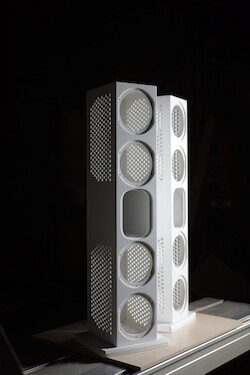
The operating principle of the speakers designed by ALD is such that their energy distribution is very even compared to traditional solutions. In practice, the sound changes in a very controlled way when moving sideways from the listening axis. In addition, the speakers direct the sound more towards the listener than usual. This means that the proportion of sound reflected from the walls and floor is smaller than in traditional speakers.
Thanks to these features, the speakers also perform well in challenging listening conditions. Even in echoing rooms, the sound remains controlled and listenable, while the reproduction of traditional speakers often starts to muffle in similar conditions.
Controlled Bass Reproduction
The new Nanomatrix bass element has been developed for the speakers, in which special attention has been paid to the interaction between the amplifier and the element. The amplifier must be able to control the movement of the element continuously so that the reproduction remains as controlled as possible. The more closely the element follows the amplifier's signal, the better the reproduction stays together even in strong bass hits.
The ability of the Nanomatrix bass element to follow the amplifier signal is exceptionally good. Thanks to this, the quality of the speakers' bass reproduction represents the highest level in their size class.
Natural Sound Image
The ALD speakers stand out most clearly from their competitors in terms of their sound image. The “sound window” they create is significantly more present and three-dimensional than in traditional speakers. The sound image is in many ways more reminiscent of the spatial effect of panel speakers than the reproduction of conventional dynamic speakers.
The most central impression in the sound of the speakers is complete purity. The sound has everything essential, but nothing superfluous.
Wave-Length Reasoning (WLR)
For most loudspeaker manufacturers, the guiding principle of loudspeaker design is to try to find loudspeaker elements whose properties correspond to the manufacturer's vision of the right sound, and which fit within the design framework intended for their price range. After this, an attempt is made to match the elements to each other by tuning the crossover. Usually, the elements are mounted as is on the surface of the cabinet. Marketing mainly emphasizes the quality of the elements and components used, while acoustic design principles often receive less attention.
Antti Louhivaara's design philosophy is based on the idea that the sound quality of a loudspeaker is determined above all in the acoustic design. Simply using high-quality elements and components is not enough if the loudspeaker's radiation, directivity and interaction of the elements are not based on a clear physical entity. Wave-Length Reasoning (WLR) is central to Louhivaara's work: The operation of a loudspeaker is based purely on the physics of wave motion. The dimensions of the speaker elements, waveguides and enclosure structures are matched to the wavelengths they reproduce. The radiators formed by the speaker elements must be in proportion to the wavelengths they produce. This ensures that the sound radiates in a controlled manner, the elements operate in their most natural ranges, and the sound reaching the listening position remains as pure and natural as possible.

Horizontal Fan-shaped Dispersion (HFD)
In addition to wavelength thinking, the importance of the directional pattern is emphasized. Instead of the traditional spherical radiation pattern, the sound waves propagate cylindrically to the listening position. The triple tweeter (HFD tweeter) developed by Antti Louhivaara, together with the bass elements placed in the D’Appolito arrangement, forms a horizontal acoustic fan, which resembles the fan-shaped jet formed by some pressure washers. We call this acoustic fan Horizontal Fan-shaped Dispersion (HFD). HFD wave formation produces significantly more direct sound to the listening position than traditional acoustic systems, and as a result, the sound image formed by the speakers is unprecedentedly deep, precise and immersive.
Constant Directional Supercardioid Radiator – ALD A10
ALD A10 takes this design philosophy to the next level. It combines key solutions developed by Louhivaara over decades: wavelength reasoning, HFD fan pattern and a constant directional supercardioid radiator based on resistance boxes.
The A10 is designed to control the speaker's directional pattern over an exceptionally wide frequency range and reduce harmful room reflections also in the lower midrange. This way, the speaker seems to detach from the room and allows the listener to hear more of the recording itself: its space, depth, dynamics and natural presence. Read more about ALD 10 in blog section.
| Business ID: FI3122763-8