
10.06.2026
ALD A10 – The Evolution of Design Theories Over 30 Years
Wave-Length Reasoning, Horizontal Fan-shaped Dispersion and constant-directivity radiation form the core of my design philosophy. With these principles, I aim to deliver an exceptional amount of direct, clean and natural sound to the listening position, reducing harmful room reflections and allowing the soundstage to open up as precise, deep and holographic. The ALD A10 takes more than 30 years of development work further than ever before by combining WLR, HFD and supercardioid technologies into one comprehensive acoustic solution.
I began studying acoustics and loudspeaker technology in the early 1980s. At the time, I was inspired by the loudspeaker kits published in Hifi magazine, and especially by the unusual structure of the Gradient 1.0 loudspeaker. I wanted to understand how these loudspeakers worked and which factors affected sound formation and, consequently, sound quality. I started designing loudspeakers as a hobby already during my student years in the 1980s by modifying existing Hifi magazine loudspeaker kits. Later, in the early 1990s, I began studying loudspeaker technology in earnest and at the same time decided to start professional loudspeaker design.
Wave-Length Reasoning
Over time, I began to grasp both the significance of total radiation and, in particular, the importance of the dimensions of the radiating systems relative to the wavelengths of the sound waves being produced. This gave rise to what I call Wave-Length Reasoning, or WLR, which would become the guiding principle in all future design work. The core idea is that the radiators formed by loudspeaker drivers must be dimensionally in harmony with the wavelengths they produce.
When this is achieved, radiation becomes as efficient as possible, meaning that the power required to reach a given sound pressure level remains as low as possible, with the resistive component of the radiation impedance being as high as possible. At the same time, the best possible integration between driver systems is achieved, along with even total radiation in different directions. As a result, the energy response is smooth and directivity is controlled. A characteristic feature of this design principle is the use of large, shallow waveguides in connection with the tweeter.
The first loudspeaker model based on WLR technology was the ASL H7, introduced in 1995.
D’Appolito - Acoustic Symmetry
Based on this thinking, I designed a more advanced prototype using a D’Appolito driver configuration. It featured 8-inch midrange drivers above and below a large waveguide, mounted in a rear-damped enclosure open at the sides. This dipole structure was an attempt to imitate a hypercardioid radiation pattern. The bass range was handled by a 10-inch driver in a sealed enclosure. The prototype was a significant step forward compared to the loudspeakers I had designed earlier. Later, the model was named Amphion Krypton, and in the next version of the loudspeaker, the midrange drivers were placed in side-breathing resistance enclosures whose radiation pattern I tuned to hypercardioid.
Although the Krypton sounded airy and immaterial thanks to its smooth power response and strong directivity, the loudspeaker displayed a certain kind of instability and was difficult to bring into a good, stable balance. This was because the waveguide itself forms an omnipolar, spherical radiation pattern, which attenuates by 6 dB when the distance doubles. The midrange drivers in the D’Appolito configuration, however, produce a cylindrical wave around the crossover region, and this attenuates by 3 dB when the distance doubles. In this kind of design system, there is an obvious discontinuity at this point. In addition, combining a cylindrical wave with a spherical wave increases instability.
Over the years, this began to bother me, and I started thinking about the best way to solve this discontinuity with as few compromises as possible. I needed to find a way to produce a coherent cylindrical wave over a sufficiently wide frequency range, starting above the bass region and continuing all the way to the highest treble.
I developed a tweeter system in which three tweeter drivers were placed as close to each other as possible in a carefully shaped waveguide. The proportions and flare of this waveguide were designed to produce a radiation pattern that would integrate perfectly with line-arranged midrange drivers producing a cylindrical wave. The result was the Aurelia Graphica. In the Graphica, the acoustic line of six bass drivers in a D’Appolito arrangement, together with the waveguide of three tweeter drivers, forms a horizontal acoustic fan that delivers significantly more direct sound to the listening position than traditional acoustic systems.
The same result cannot be achieved simply by taking a ribbon tweeter and designing a D’Appolito-style speaker around it. Nor, for that matter, can long line sources deliver an equally coherent performance in every respect; other forms of acoustic synergy are required.
This approach works only when "Wavelength Reasoning" (WLR) is combined with this fan-like wave formation. In other words, one must ensure that each radiator system handles only those wavelengths suited to its physical dimensions. In the case of the Graphica, the mid-bass drivers handle wavelengths exceeding 24 cm, while the triple-tweeter system handles wavelengths shorter than 24 cm. Only in this way can the coherent radiation necessary for the Graphica’s soundstage be achieved. This also requires the drivers to be purpose-built for this specific system.
Fan-like wave formation arises when using radiator systems that are each capable of generating cylindrical waves within their respective, limited frequency bands. It is essential that the radiators behave consistently at the crossover frequency; consequently, the filtering must operate in a complementary manner to ensure the most stable result. Only by combining wavelength reasoning with a fan-like radiation pattern does the wave formation become stable.
When discussing directivity in the traditional sense, the reference is usually an omnipolar, spherical radiation pattern. Both traditional two-way loudspeakers with waveguides and loudspeakers equipped with coaxial drivers form a spherically propagating wavefront, whose directivity index can be adjusted through factors such as driver proportions and waveguide flare.
Horizontal Fan-shaped Dispersion – HFD
With the Graphica, however, I realized that a fan-shaped radiation pattern produces clearly more direct sound at the listening position compared to an omnipolar, spherical radiation pattern. The phenomenon is somewhat similar to the fan-shaped spray produced by certain pressure washers, such as Kärcher, compared to a spherical spray. In that case, too, the fan-shaped pattern focuses the water jet most effectively where it is needed most.
I call this radiation pattern Horizontal Fan-shaped Dispersion, or HFD. This pattern radiates very widely in the horizontal direction, but is narrow and strongly controlled in the vertical direction.
The result is a three-dimensional, holographic soundstage. The very first experiments with the original Graphica prototype immediately showed that the Graphica’s acoustic system tied everything together at once. Since then, there has been no need to look back.
The ALD A10 Goes Further Acoustically
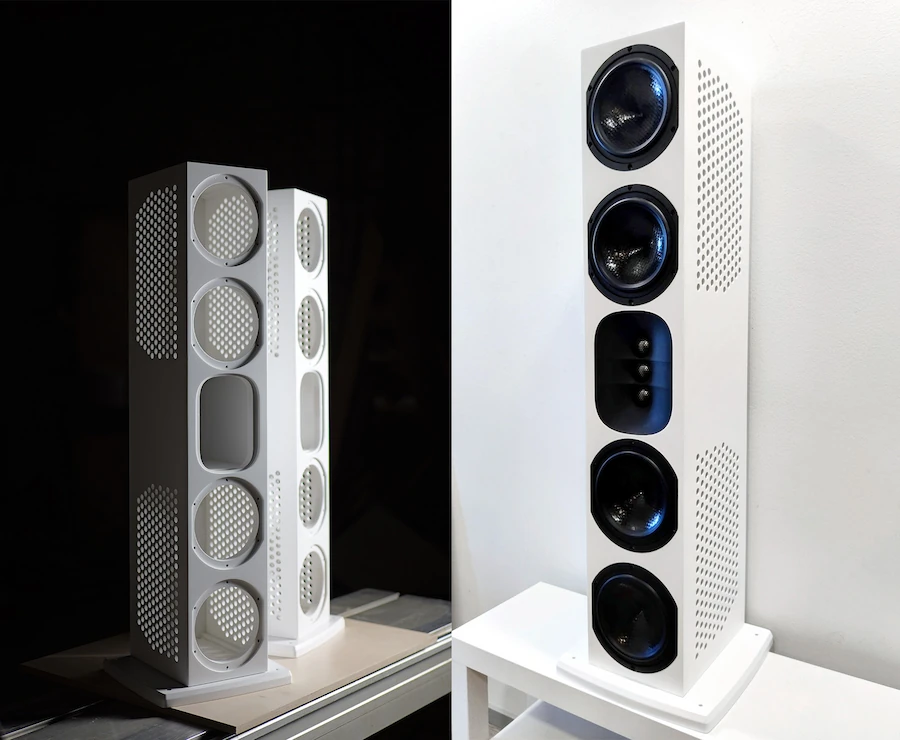
Now, the ALD A10 takes this acoustic thinking even further. In this acoustic solution, I tune the radiation pattern to the sides and also to the rear of the loudspeaker so that it corresponds to the radiation pattern of the triple-tweeter system. For this reason, the four midrange drivers arranged in a line in the A10 are placed in resistance enclosures whose radiation pattern is tuned to supercardioid. The loudspeaker is therefore almost constant-directive from approximately 100 Hz upward. The speaker produces a coherent cylindrical wave from 150 Hz upward.
The lower cut-off frequency of the loudspeaker is 60 Hz, which serves as the crossover frequency for the subwoofers used with the speaker. The intention is to use one high-quality subwoofer with each loudspeaker.
The loudspeaker is therefore a constant directional supercardioid radiator with horizontal fan-shaped dispersion. Quite a marketing name!
The ALD A10 sums up all the expertise I have accumulated over the past 30 years and combines all the design techniques I have used during that time:
- Wave-Length Reasoning, WLR
- Horizontal Fan-shaped Dispersion, HFD
- Constant Directional Supercardioid Radiator
The ALD A10 solves three of the most difficult challenges in loudspeaker design simultaneously::
1. Continuity of the radiation pattern, or Constant Directivity: It is essential that the supercardioid pattern remains constant down to 100 Hz through the use of aperiodic enclosure design. Loudspeakers usually become omnidirectional below a few hundred hertz, which disturbs room acoustics in the lower midrange. Because the A10 maintains the same “fan” through the entire critical frequency range, the ear does not perceive coloration between the tweeter and midrange caused by changes in directivity.
2. A coherent cylindrical wave from 150 Hz upward: When this is combined with the properties of the triple tweeter, the result is an exceptionally stable stereo image. Because the sound does not attenuate with distance in the same way as a spherical wave, the listening experience becomes more physical and present.
3. Seamless integration of the upper bass range (60–150 Hz) with the listening room: That range (60–150 Hz) is often the "problem area" where many speakers lose their punchiness. The lateral and rear damping achieved by the A10’s aperiodic enclosures ensures that percussive sounds retain their speed even at these critical transition frequencies.
I am currently carrying out my own listening comparisons using an improved version of the Cerica XL as a reference. The Cerica XL received SoundStage! Hi-Fi’s Product of the Year award in 2021 for innovative design. This improved version corresponds in quality to the original Graphica.
This A10 prototype evokes the same sense of amazement in me that the Graphica once did when compared to the Amphion Krypton, creating a soundstage that is an order of magnitude more convincing than that of the Cerica XL. The leap in sound quality is surprisingly large, even to me. I look forward to seeing how the A10 compares to the very best loudspeakers on the market.
My Legacy
When I first introduced the ASL H7 model in 1995, based on Wave-Length Reasoning and equipped with a large waveguide, there were no comparable loudspeakers on the market. The amount of criticism directed at my design was enormous. I constantly heard comments about “wrong” design, horn sound, and a crossover frequency that was supposedly too low and would cause distortion, and so on.
Then, when the Amphion Argon2 and Amphion Xenon began gaining recognition in the international press and at major international shows, the tone started to change. One of the industry’s most influential and respected hi-fi journalists even put it this way: “If loudspeakers had originally been designed the way you design them, and someone then brought traditionally designed loudspeakers to the market, he would be laughed out of the room.”
Today, there are dozens of loudspeakers on the market equipped with similar waveguides, many of which look almost like copies of loudspeakers I designed. Functional new principles always seem to eventually overcome old traditional methods.
When Aurelia introduced its first triple-tweeter model, the Graphica, in 2008, the criticism was even harsher. I constantly heard that it was wrongly designed, that the treble would split into lobes, and so on. In the beginning, the feedback was even hostile.
The more the Horizontal Fan-shaped Dispersion radiation pattern I introduced received praise in international publications, the faster the criticism faded. Cerica, in particular, in its various versions, received even more praise in the international press than the Amphion models of the early 2000s.
I am very interested to see what kind of reception the ALD A10 will receive. Will the group of skeptics still be as large and fanatical as it once was with the Amphions and Aurelials...
In my design philosophy, there is no room for imagery, snake-oil solutions or mysticism. My design work is based entirely on pure mathematics and applied physics. This is my contribution to the history of Finnish loudspeaker design so far. The work still continues, and new models are still on the drawing board. Hopefully I will get to present those as well to all of you who love good sound.
Antti Louhivaara
Read more about the subject
| Business ID: FI3122763-8